

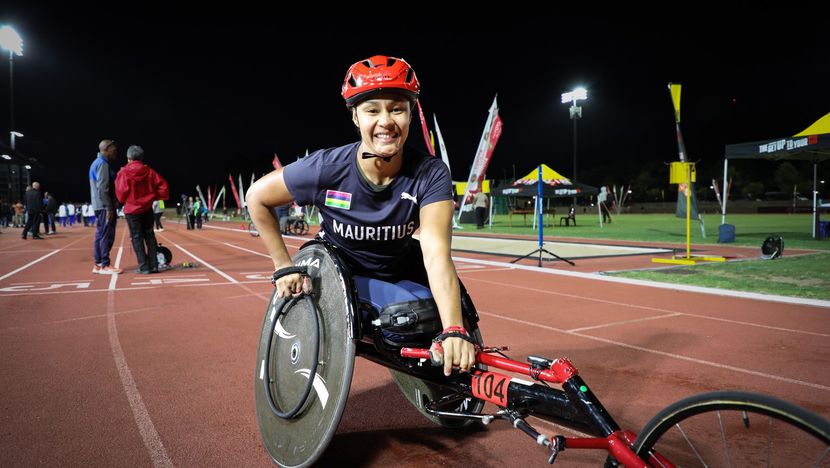
‘I am Wonder Woman’ - Noemi Alphonse
One of the first things you notice about World Champion wheelchair racer Noemi Alphonse is her brightly coloured prosthetic leg. Clad in the logos and images of Wonder Woman, the leg symbolises Noemi’s resilience and refusal to hide her disability from the world.
However, this was not always the case for Noemi. Her leg is the embodiment of her journey in Para sport and her route to believing in herself!
Born with a disability, Noemi had her leg amputated early in life and is also missing fingers on her hands. Growing up in Mauritius, she was painfully aware of how disability was seen around her.
“In Mauritius, when you have a disability, you don’t really have a place in society, they pity you and I didn’t really like that,” she said.
That sense of being seen differently made her want to disappear.
“I was always trying to hide it every time with long pants, long sleeves,” she said.
When she was eight years old, Noemi’s mum put her into a judo class which she hoped would help with Noemi’s shyness and also give her the confidence to protect herself against bullies at school.
“When I was eight, I was very shy and I didn't know how to defend myself.”
Noemi was 19 when she started wheelchair racing and met her coach.
“I really embraced my disability when I first met my coach, Jean Marie. When I met him and met the other athletes with disability, I was like, ‘Oh, I thought I was the only one with a disability in Mauritius.’”
That confidence grew when Noemi went to her first competition and saw athletes with different disabilities embracing who they were.
“At my first competition I saw different athletes with different types of disability, and they were living with so much joy and being really happy and embracing it,” she said.
Returning home from that competition, Noemi started to wear short sleeved tops and shorts, deciding to change the perceptions of disability in Mauritius herself.
“When I came back to Mauritius everything changed for me,” she said. “I said to my mom, ‘I don’t want to wear long pants anymore. I want to show Mauritians my disability.’
“When I started showing my disability and bringing medals back to Mauritius, we really inspired young athletes and young Para athletes.
“We were able to show them that through sports, whilst we are disabled, we can still do things our way.”
In 2018, Noemi competed at the Gold Coast 2018 Commonwealth Games, her first international competition, which she says was eye opening.
Although she didn’t medal due to a flat tyre in the 1500m final, Noemi described the experience as life changing, meeting Para athletes she had idolised and competing against them.
In 2020, Noemi would be the first Mauritian Para athlete to reach a final at a Paralympics, an achievement that made her a local star and a recognised name in the wheelchair racing community.
Ahead of the Birmingham 2022 Commonwealth Games, Noemi was invited to attend a Pre-Games GAPS camp with other Commonwealth Para athletes.
Describing the camp as a ‘mini-Commonwealth Games’, Noemi was surrounded by Para athletes who all wanted to walk away with a medal from the Games. She remembered the competitive spirit and supportive atmosphere of all the athletes who were all connected by their love of sport.
“We put ourselves in the Games, and we think there's only one week (to go), if we need to adjust something at the last week this is the opportunity to do so.
“We also get to meet all the other athletes, and we cheer on everyone to give the last talk, the last motivation you need to give to your friends.”
Noemi wouldn’t medal at Birmingham 2022 but would later go onto become a two-time world champion in the women’s T54 100m.
With the Glasgow 2026 Commonwealth Games fast approaching, Noemi has been focusing on her preparation, attending the 2026 Stellenbosch GAPS camp earlier this year to aid her battle for gold.
“When I was accepted for GAPS again, I was really stressed. I’ve never been to South Africa, and I get shy when I meet new athletes and I don't know what to say.
“What I like with GAPS is that I get to share what I learn and give it to somebody else who is also trying to learn. The sense of camaraderie is the best thing that comes out of these camps. We share our stories.”
Much like the superhero on her leg, Noemi’s story is one of resilience and strength as she continues to showcase her disability to try and change perceptions of what it means to be a Para athlete.
“Sometimes we don't see who we are but every time I see the picture on my leg, I just remember that I am Wonder Woman.
“This type of leg attracts children a lot. They always ask me ‘what happened to your leg, what is that?'. I say, 'I am a superhero, I am Wonder Woman'”
For Noemi, however, the message now reaches beyond medals.
“Before I was like, ‘I want medals. I want African records,’” she said. “But with time it changed, because I saw that when some children come to me and say, ‘I want to be just like you, a champion. Look at your leg, it’s fashion. I want a leg just like you.’”
That impact, she says, is what will matter most when her racing career is over.
“Yes, medals are good to have, but this is the message that you leave after you finish your sports career. This is what stays. The way that you make people feel, this is what really stays.”
For Noemi, the leg she once tried to hide has become part of the message: a symbol of resilience, confidence and the courage to be seen.
Watch Noemi's story here...
GAPS is a multi-stakeholder partnership programme developed for emerging athletes and coaches, providing access to additional skills, knowledge and resources with the aim of advancing education, removing barriers to participation, and supporting the development of inclusive sports pathways that promote positive social change in sport and local communities.
