

Road tennis and the shape of sport
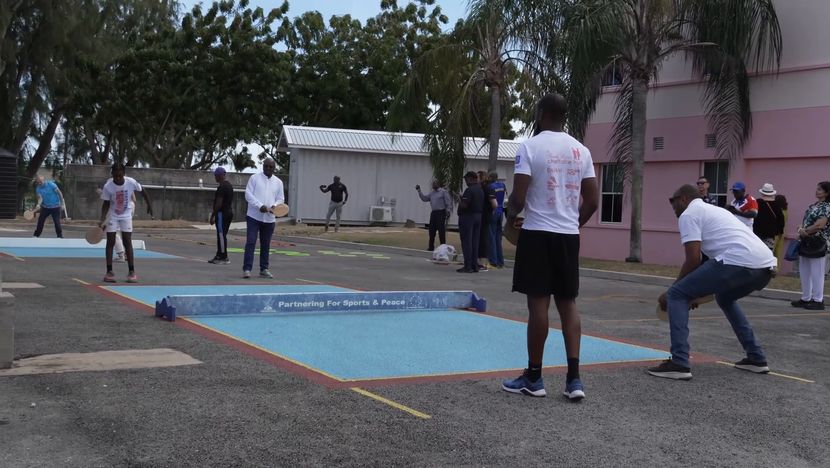
The Commonwealth Sport Executive Board recently visited the island of Barbados and got to see first-hand how the hugely popular sport of Road Tennis has been moulded by the nation. It offers a reminder of how sport takes shape in the places that build it.
Chalk lines on the road, a piece of wood stretched across for a net, and a ball that barely bounces. In Barbados, this is Road Tennis, a sport shaped not by design but by restriction, and one that carries a history that still sits just beneath the surface of how it is played today.
In the 1930s, Lawn Tennis courts existed on the island, but access to them did not. They were tied to clubs, to class, to the boundaries of who was allowed in and who was not.
The game did not disappear, it moved. It shifted out of those spaces and onto the road, into neighbourhoods and into places where it could be played without permission or barrier. The way the game is played still reflects that shift. Old tennis balls are stripped of their felt so they stay low on the hard surface, flattening the bounce and speeding everything up.
Rallies are played close to the ground, reactions are shortened, and there is very little margin for error. What looks simple from a distance sharpens quickly once you are in it. It was never meant to replicate tennis, and it does not need to. It exists on its own terms, shaped by the conditions that created it and sustained by the people who continue to play it.
Across Barbados, Road Tennis is not something staged or preserved, it is part of daily life. It is played in streets, passed between generations, and understood without needing explanation. It carries identity in a way that cannot easily be lifted out and reproduced elsewhere.
That was evident during the recent Commonwealth Sport Executive Board visit to the island. Senior officials met with national leadership as part of a wider effort to strengthen relationships and better understand how sport is experienced across different contexts.
For smaller nations, where hosting a major sporting event is not yet a realistic opportunity, the ability to host a visit such as this can offer a rare opportunity to engage at a high level within the Movement. Those conversations took place in formal settings, in meeting-rooms and at established venues such as Kensington Oval, and were supported by visits to key cultural sites across the island. But those settings only tell part of the story.
During the visit, Commonwealth Sport representatives were introduced to Road Tennis in its natural setting, played in the streets where it has long existed. It is a game that explains itself quickly. The ball stays low, the exchanges come fast, and there is little time to adjust. For a moment, the distance between those shaping sport and those playing it narrows, not through discussion or structure, but through experience.
Road Tennis can be played anywhere, but it does not mean the same everywhere. In Barbados, it carries something deeper than the game itself.
There are efforts to grow it beyond Barbados, through competitions and governing structures, but its strength lies in where it comes from and in the fact that it does not need to change to justify its place.
It already belongs.
