

The KBR in Oceania - where connections ran deep
Across Oceania, the King’s Baton Relay moved from island to island, where land, ocean and identity shape daily life. Beginning in the Solomon Islands and concluding in Australia, the Relay travelled steadily across the Pacific on the road to the Commonwealth Games Glasgow 2026, shaped by culture, environmental action and community-led participation.
The year opened in the Solomon Islands with a community-led clean-up at Tanahoru in Honiara, delivered as part of the Royal Commonwealth Society’s Commonwealth Clean Oceans Plastics Campaign, followed by a relay route through the city that brought together athletes, officials and residents. That sense of local ownership set the tone as the Baton continued across Oceania.
Papua New Guinea brought a broader expression of identity, combining community activity with Baton design that reflected sport, culture and the idea of hosting.
“The presence of the King’s Baton is both simple and deeply meaningful,” said Papua New Guinea Governor General Sir Bob Dadae.
It marks a time for reflection on our identity as a people while reaffirming our place within the wider Commonwealth and global community.”
Environmental activity linked to the Royal Commonwealth Society’s Commonwealth Clean Oceans Plastics Campaign continued alongside the programme, reflecting a regional commitment to protecting coastal environments.
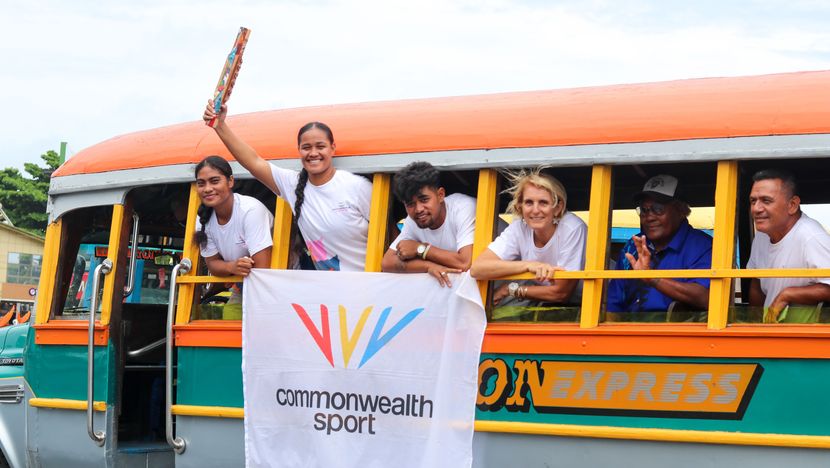
The Relay then moved through smaller island nations where participation became more closely embedded in community life. Across Nauru and Niue, programmes brought people together through sport, schools and coastal activity, while Samoa welcomed the Baton through cultural ceremony.
“The uniquely designed baton is a wonderful expression of Samoan culture, sporting prowess and national spirit,” said British High Commissioner to Samoa Gareth Hoar.
“It is a symbol of the connections between communities in Samoa and across the Commonwealth.”
That sense of shared purpose continued in Tonga, where leadership and volunteers came together through Relay activity and coastal clean-ups, while Vanuatu balanced youth engagement with environmental action and a strong expression of national pride.
“The Games are important for developing Tongan sporting talent, but the platform they provide and the opportunity to build relationships across the Commonwealth are just as significant as the competition itself,” said Team Tonga chef-de-mission Roman Vaihu.
“It is fitting that Vanuatu’s word on the baton is Pride,” added British High Commissioner to Vanuatu Nicolette Brent.
“Pride in culture, pride in land, pride in people, and pride in the athletes who represent the nation.”
That relationship between people and ocean became more visible as the Relay moved through Kiribati and Tuvalu, where the Baton passed through schools, villages and coastlines, becoming part of daily life. In Kiribati, large-scale clean-up activity along the Dai Nippon Causeway brought together community groups, federations and volunteers, reinforcing the importance of environmental action across the region.
The journey then moved into Fiji, where the programme extended across islands, highlands and cities, bringing people together through ceremony, sport and environmental activity.
“The fact that Commonwealth nations have come together to celebrate Fiji’s Baton programme is significant,” said FASANOC chief executive officer Vanessa Kilner. “It shows the strength of our Commonwealth partnership.”
In the Cook Islands, the Baton continued with a strong focus on identity, unity and environment, reflected in both activity and Baton design.
“Within this baton travels a message of unity, hope and enduring friendship that binds our 74 Commonwealth nations together,” said Cook Islands Sports and National Olympic Committee Secretary General Geoffrey Halston.
The Relay then continued to Norfolk Island, where one of the smallest communities in the Commonwealth marked its place through participation and local pride. Activity moved through community spaces and the island’s only school, where students engaged directly with the Baton and its story. Designed by three students from Norfolk Island Central School, the Baton reflected identity, heritage and environment, reinforcing a programme shaped by local heritage and environment.
In New Zealand, the Relay moved from Dunedin to the upper North Island, where community-led activity, cultural connection and environmental action defined the programme. From a community fun-run in Dunedin to school engagement in Huntly and a large-scale clean-up at Tāwharanui Peninsula, the journey reflected a consistent focus on participation and shared experience.
“The special thing about the Commonwealth Games is that para and able-bodied athletes compete together,” said New Zealand swimmer Dame Sophie Pascoe.
“That sense of unity across the sporting community is what really stands out.”
The Relay then moved into its final stage across Australia, where the journey stretched from Uluru to Launceston, combining landscape, participation and environmental action to close the Oceania leg.
From Uluru to the Great Barrier Reef and through to large-scale clean-up activity in Townsville, the programme maintained a clear focus on environment and engagement, before concluding in Launceston where Ariarne Titmus returned to the pool where her career began.
Australia’s Baton, designed by Kalkadoon artist Chern’ee Sutton, reflected the relationship between culture, community and place.
“I’m really hoping people take away connection,” Sutton said. “Connection to community, connection to each other and connection to culture.”
Across Oceania, the King’s Baton Relay was shaped by how it moved through communities rather than the distance it travelled. From village to village and island to island, each nation and territory added its own voice, shaping a shared story defined by identity, participation and responsibility on the road to Glasgow 2026.
