

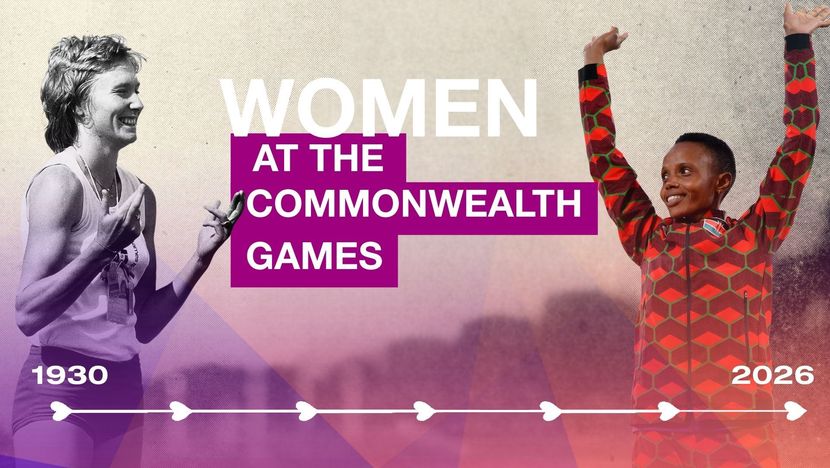
Defining Moments: Women at the Commonwealth Games
These are the milestones that reshaped the programme and redefined opportunity across nearly a century.
From five swimming events in 1930 to a programme in which women competed for more medal events than men in 2022, the evolution of women’s sport at the Commonwealth Games has been deliberate, layered and structural.
1930: Women included in the inaugural Games
At the inaugural Commonwealth Games in Hamilton in 1930, women were included but only in aquatics. Five swimming events and two diving competitions formed the entirety of the women’s programme.
England’s Joyce Cooper dominated the pool, winning four gold medals. Cecilia Wolstenholme set a world record in the 200-yard breaststroke. Valerie Davies carried the Welsh flag and won medals for Wales, while South Africa’s Oonagh Whitsett secured gold in the women’s springboard diving.
Women were present from the start, but within clearly defined limits.
1934: Women’s athletics introduced
London 1934 marked the first significant expansion of women’s sport at the Games. Athletics events were added, including the 100 and 220-yard sprints, hurdles and relay races, alongside field events such as the high jump, long jump and javelin.
Eileen Hiscock won sprint gold for England, while Gladys Lunn became the first women’s javelin champion at the Commonwealth Games.
1954: Field events expand
The 1950 Games in Auckland and the 1954 Games in Vancouver saw further development in women’s athletics. New Zealand’s Yvette Corlett won gold in the long jump in 1950 and later claimed shot put and discus titles after those events were added to the programme in 1954.
The athletics schedule for women was no longer confined to sprint events and selected jumps. Throwing disciplines were now firmly embedded.
1960s: Women become headline Athletes
By the 1960s women were no longer marginal participants but central figures in the Games. Australia’s Dawn Fraser dominated swimming across multiple competitions and became one of the most recognisable Athletes of her era.
Her success reflected the growing prominence of women’s sport within the Commonwealth Games programme.
1970s: Competitive depth increases
The Games in Edinburgh in 1970 and 1974 highlighted the growing competitiveness of women’s athletics. Raelene Boyle’s sprint performances demonstrated the increasing depth of the women’s field, while Sabina Chebichi became the first Kenyan woman to win a Commonwealth Games medal with bronze in the 800 metres.
Women’s participation was expanding not only in events but in global representation.
1986: The women’s marathon arrives
More than half a century after women first competed at the Games, the women’s marathon was introduced in Edinburgh in 1986.
Australia’s Lisa Ondieki won the inaugural race and successfully defended her title at the Auckland Games in 1990, establishing the marathon as a permanent feature of the athletics programme.
1998: Netball becomes a medal sport
Netball appeared as a demonstration sport in 1990 before gaining full medal status at the Kuala Lumpur Games in 1998.
Australia won the first gold medal, with New Zealand taking silver. Netball became the first women-only team sport on the Commonwealth Games programme.
2002: Integration strengthens inclusion
Manchester 2002 marked a turning point for inclusive competition. Women’s weightlifting was introduced, with Reanna Solomon of Nauru and Madeleine Yamechi of Cameroon among the first champions.
The Games also strengthened the integration of Para sport into the main programme. South Africa’s Natalie du Toit won multi-disability freestyle gold and qualified for the able-bodied 800 metre freestyle final.
2010: Women’s wrestling added to the programme
Wrestling had been part of the Commonwealth Games since the inaugural competition in Hamilton in 1930, but for eight decades it remained a men-only sport.
Women’s wrestling was finally introduced at the Delhi Games in 2010, marking a significant expansion in combat sports at the Commonwealth level. India’s Geeta Phogat won gold in the 55 kg freestyle event, becoming one of the first female Commonwealth wrestling champions.
Her victory marked both a sporting milestone and a shift in opportunity within a discipline that had been closed to women at the Games for eighty years.
2014: Women’s boxing enters the Games
Women’s boxing made its Commonwealth Games debut at Glasgow 2014. Nicola Adams won flyweight gold for England, while Savannah Marshall secured the middleweight title.
The inclusion of boxing represented another significant step for women in combat sport at the Games.
2018: Medal event parity achieved
The Gold Coast Games in 2018 became the first major multi-sport event to deliver equal numbers of medal events for women and men.
The programme design now reflected structural equality.
2022: Women compete for more medal events than men
At Birmingham 2022, women competed for 136 medal events compared with 134 for men. Eight integrated Para sports also contributed to the overall medal table.
The Games had moved beyond participation to a programme where women’s competition shaped the structure of the event.
2026: Boxing weight classes reach parity
Glasgow 2026 will become the first Commonwealth Games to feature the same number of boxing weight classes for men and women. Seven categories have been confirmed for each.
Women’s boxing first appeared at the Games in 2014 with three weight divisions. Twelve years later the programme will reach full competitive parity.
Commonwealth Sport is proud to have played a role in championing women’s participation in multi-sport events, redefining the opportunities across nearly a century of Games.
