

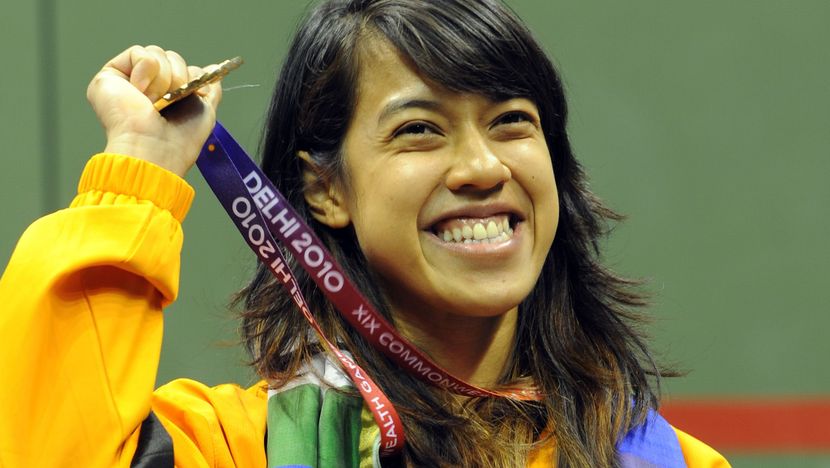
Where Are They Now: Nicol David
We continue the series of articles exploring the journeys of past, present and future athletes who have participated in a Commonwealth Games event. In this edition, we reconnect with Malaysian squash icon and multiple Commonwealth Games medallist Nicol David.
Widely regarded as one of the greatest players in the history of the sport, she won four Commonwealth Games medals during her career, including singles gold in Delhi in 2010 and Glasgow in 2014.
She also claimed a mixed doubles silver medal in Manchester in 2002 and a mixed doubles bronze medal in Delhi in 2010, placing her among Malaysia’s most successful Commonwealth athletes.
Alongside her Games achievements, she became an eight-time World Champion and spent nine years as world number one, making her one of the most recognisable figures in the sport.
Today she leads the Nicol David Organisation, using sport, education and wellbeing to support young people and families across Malaysia.

What stands out most from your time competing at the Commonwealth Games?
The atmosphere of the Commonwealth Games always made a strong impression on me. Being in the Games Village with athletes from so many nations created a special energy. Winning my first singles gold medal in Delhi is a memory I will always cherish. It was my first multisport gold medal and it meant a great deal.
How did your experience at the Games shape your view of squash and your own achievements?
The Commonwealth Games played a major role in my development. When squash was included for the first time in Kuala Lumpur in 1998, I was twelve years old and received support from the Malaysian government. My performance improved and I began working with experts. By fourteen I was competing at senior level. Representing Malaysia in Kuala Lumpur and walking into the stadium with eighty thousand people cheering for us was one of the greatest moments of my life and shaped my belief that I could pursue squash professionally.
How has life changed for you since retiring from competition?
My life has changed completely. I now run the Nicol David Organisation and sport remains at the heart of what I do because I know its power to bring people together. My focus is on helping others. Seeing children become more confident, seeing families take part in community activities and creating a safe space for young people to grow makes this chapter very fulfilling.
What challenges or turning points have defined your journey since your Commonwealth Games days?
After becoming world number one and world champion, I struggled with the expectations that came with it. I was twenty two when I competed at the Melbourne Games and I did not yet fully believe that I deserved the world champion title. I did not win a medal and it was heartbreaking. It became a turning point. My coach Liz Irving encouraged me to shift my focus from results to performance. We set new goals and concentrated on improvement. Once that change happened, everything moved forward.
Do you still stay involved in squash or the wider sporting community?
I am not active on the professional tour but squash is included in my foundation programme called Little Legends. We provide children from low-income families with squash training and English tutoring. More than one hundred and fifty children aged between eight and eleven are part of the programme. It is wonderful to see them enjoy the sport and feel proud to call themselves squash players and Little Legends.
Can you tell us more about the Nicol David Organisation and its impact?
Our organisation works across three main areas. The children’s pillar provides squash and English classes and currently supports one hundred and fifty children. The families pillar focuses on mother support through mental health and financial education sessions, with seventy-five mothers taking part so far. The outreach pillar works with public schools to deliver movement and mental health sessions after class. In its first year it reached forty-two schools and more than one thousand three hundred students. The biggest impact is seeing confidence grow and communities strengthen.
How have your Commonwealth Games experiences influenced the way you mentor the next generation?
The Games gave me the belief that I could represent my country at the highest level. I hope to pass that feeling on to young athletes. Whether at grassroots level, among aspiring juniors or among elite players, I want them to believe in their abilities and aim for excellence.
What lessons or values from your sporting career have been most valuable to you?
Discipline, respect, adaptability and resilience guided me throughout my career. They now guide me in leading my foundation and working with communities.
Is there an achievement since the Games that you are especially proud of?
Winning my second singles gold medal in Glasgow stands out. It was a difficult season but I found a way to perform when it mattered.
Did the recent visit of the King’s Baton Relay to Malaysia bring back any memories?
It reminded me of where my Commonwealth Games story began in 1998. Being part of the Baton Relay then was very special. For every country, the Baton brings a moment that becomes part of their own story.
What advice would you share with athletes preparing for the 2026 Games?
Prepare well and listen to your body. Recover after every session and take time to refresh. Enjoy the journey because the Commonwealth Games is always an incredible experience.
