


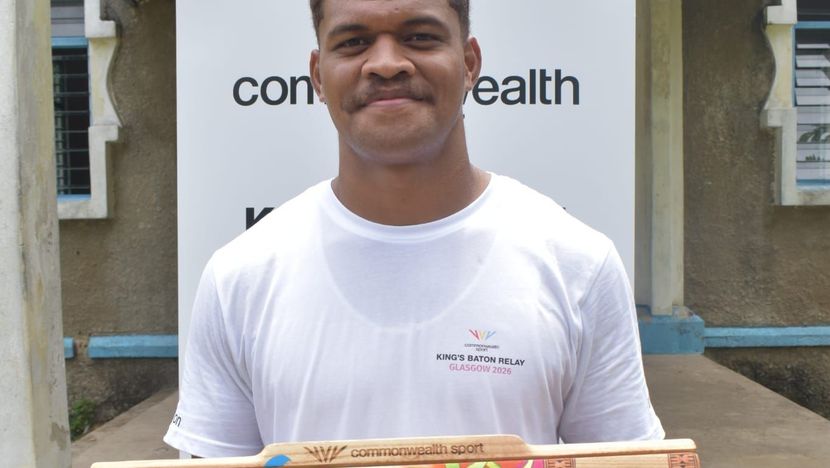
The King’s Baton Relay in Fiji unfolded from 25 February to 2 March, moving across islands, coastlines and highlands in a programme shaped by community, culture, sport and faith.
The Relay began in the Yasawa Islands, where the Baton was taken to Soso Village on Naviti Island. After travelling by road and then by boat across open water, the Baton was formally presented to the Turaga na Tui Naviti in a traditional ceremony led by the Minister for Youth and Sports, Hon. Jese Saukuru. A sevusevu, a traditional ceremony to seek permission and blessing from village elders, was performed as the sound of the lali, a traditional wooden drum used to signal gatherings, echoed across the village. The delegation was welcomed by chiefs and landowners before the Baton was blessed, grounding its journey in the authority of the Vanua. Batonbearers including national rugby sevens representatives Sakiusa Siqila and Josese Batirerega took part in the opening stage.
From the islands, the Relay moved into Suva on 26 February, beginning at Albert Park where Heads of Missions from Commonwealth nations took part in a Mini Baton Relay. Along the route to the National War Memorial, students formed a guard of honour, lining the streets as the Baton was carried through the capital. At the memorial, wreaths were laid by military representatives, the British High Commission and ex-servicemen, linking the Relay to remembrance as well as celebration. Senior figures including Minister for Education Aseri Radrodro and members of the Commonwealth diplomatic community were in attendance.
The Baton then travelled beyond the capital into communities often removed from national events. In the Naitasiri Highlands, it was taken to Naitasiri High School and Soloira District School, marking the first time the Baton had reached these areas. The visit brought the Relay directly into rural communities, connecting students to the wider Commonwealth journey and reinforcing that the path to the Games extends beyond urban centres.
On 27 February, the Relay moved west, connecting with partners, schools and sporting communities across the Western Division. It stopped at the Ministry of Youth and Sports and the Fijian Broadcasting Corporation before continuing through Pacific Harbour to the Damodar Arts Village, where culture and sport met. School visits remained central, including Ratu Filise Memorial School in Namatakula, a village known for producing international rugby players. At Govind Park, the Baton was presented during Fiji’s FIFA Women’s World Cup qualifier against New Caledonia, placing it at the centre of a significant moment for women’s sport in the country. Batonbearers including Sisilia Naisiga and Vaciseva Tavaga were part of the day’s programme.
The following day saw large-scale community engagement through clean-up campaigns in Suva and Nadi, delivered in partnership with Save Our Fiji as part of the Commonwealth Clean Oceans Plastics Campaign. Volunteers from schools, sporting federations, embassies and the public gathered along the coastline, collecting waste and reinforcing the connection between environmental responsibility and island life. The Baton later travelled to Churchill Park in Lautoka, where it was showcased during the Fijian Drua’s Super Rugby Pacific match against the Hurricanes. The Drua’s 25 to 20 victory, their first of the season, turned the moment into a celebration of national pride. The day concluded at Vuda Marina, where Olympic sailor Viliame Ratulu represented Fiji’s connection to the ocean.
Across the programme, Fiji’s Baton itself became a central expression of identity. One side reflects pride in culture and environment, featuring endemic species such as the Fiji banded iguana and Tagimoucia flower alongside traditional artefacts and the sand dunes of Sigatoka. Another speaks to the ocean, with flowing resin, shells gathered from Fijian shores and sand from Rotuma, anchored by the drua as a symbol of navigation and unity. The third celebrates solesolevaki, the Fijian concept of working together, with imagery of sailing canoes, floral motifs and the tabua at its centre as a symbol of honour and respect. Together, the design presents Fiji as resilient, ocean-connected and grounded in community.
On 1 March, the Baton returned to Suva, where it formed part of a coastal clean-up led by youth representatives from 33 Seventh-day Adventist churches. It was then taken into Sacred Heart Cathedral during a Sunday service, where it was placed at the altar as part of regular worship, reflecting the close relationship between faith and sport in Fiji. Planned activities were affected by a Category 2 cyclone passing through the region.
The Relay concluded on 2 March in Levuka, Fiji’s former capital. After a traditional sevusevu to seek permission for the visit, the Baton was carried through key sites including St John’s College, Levuka Public Secondary School, the Weightlifting Gym and the Levuka War Memorial. It also appeared at the Deed of Cession site, connecting Fiji’s history to its present-day place within the Commonwealth. The final stop at the Office of the Commissioner for the Central Division recognised the role of government in supporting sport across the country.
Across the week, the King’s Baton Relay moved between islands, highlands and cities, connecting communities through shared moments of participation and reflection.
From village ceremonies to international sporting stages, Fiji’s King’s Baton Relay reflected the nation itself, grounded in tradition, driven by community and carried forward through sport.
