


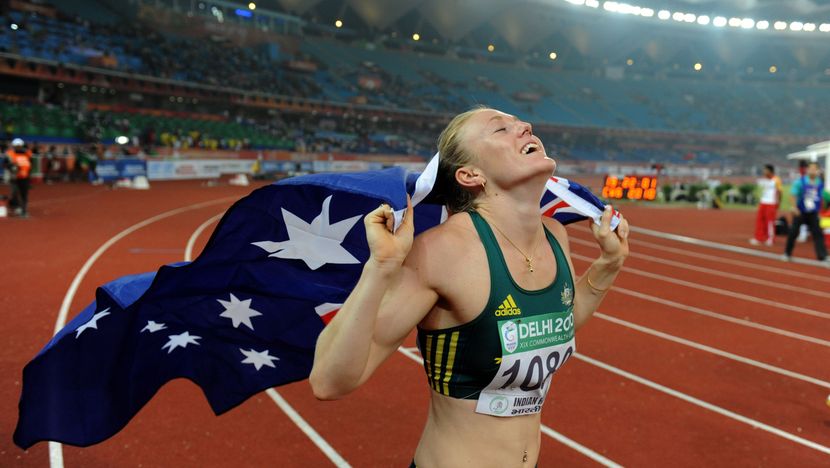
From the noise of a home Commonwealth Games in Melbourne to the decisions that shaped her career, Pearson’s journey has been defined as much by restraint as success. Now working in media and mentoring the next generation, she reflects on the moments that tested her, the lessons that stayed, and the reality of life beyond elite sport.
What are your standout memories from competing at the Commonwealth Games?
Melbourne 2006 will always be the one that stays with me. It was my first senior championships where I was competing as an individual, and doing that at a home Games was overwhelming in the best way. Melbourne is such a sporting city and the atmosphere inside the stadium was unlike anything I had experienced before. I remember standing there and feeling like the entire place was shaking.
I had been to major championships before, but nothing prepares you for hearing your name called out in front of that many people. At first, it almost catches you out. You want to soak it all in, but you still have a job to do. That was a big learning moment for me, understanding how to enjoy the crowd without letting it pull you away from what you need to focus on.
How did those early Commonwealth Games experiences shape you as an athlete?
They taught me very quickly how to deal with pressure. I remember going to the World Championships earlier in my career and being almost distracted by the size of the crowd. At the Commonwealth Games, especially at home, you learn fast that you cannot afford to drift mentally.
Over time, I learned to love that feeling. I loved performing in front of people once I understood how to manage it. That balance between soaking it in and locking in became something I relied on throughout my career.
What challenges and victories from the Commonwealth Games stand out most for you?
Melbourne was where I realised how badly I wanted to win and how much I enjoyed the process of figuring out how to become better. It made me curious. How do you train smarter. How do you prepare mentally. How do you come back four years later stronger than before.
But there were also moments that were incredibly difficult. In 2018, I wanted to run the 100 metres at the Commonwealth Games, especially with it being at home. I had to make a decision that no athlete ever wants to make. I could push through and risk my entire career, or I could pull out and protect my future.
Either way, it felt like losing. Pulling out was devastating. It is still something that hurts when I think about it because you do not get many chances to compete at a home Games. It was the right decision for my career, but that does not make it easy emotionally.
Have you stayed involved in athletics since retiring?
Yes, in different ways. I have done some coaching and mentoring, including working with a young athlete on the Gold Coast. What surprised me was how much it pulled me back into that high performance mindset.
You forget how intense elite sport is until you start having those long conversations again about training, decision making and mindset. Sometimes we would talk for an hour without realising it. I really enjoyed that because it reminded me why I loved the sport in the first place.
What are you focusing on now?
I have moved into television and media, which has been a completely new challenge. Learning a new skill from scratch has been humbling. It is high pressure in a different way, and there are days where you feel like you are failing or not being heard.
But the process feels familiar. You keep showing up, you keep learning, and you trust that it will come together. That resilience definitely comes from sport.
What lessons from your Commonwealth Games journey have helped you in this next chapter?
Being comfortable in front of people is a big one. Competing taught me how to handle scrutiny and expectation. It also taught me not to give up when things feel uncomfortable.
In sport, you learn that progress is rarely linear. That applies just as much outside of it. Sometimes you are learning without realising it.
How has life changed since stepping away from elite sport?
When you are competing, you live in a very small bubble. Everything revolves around training, recovery and performance. Stepping away from that has allowed me to see the world more openly.
It took time to be okay with that shift, but now I really appreciate it. There is more space to reflect, to explore different interests, and to understand who you are beyond being an athlete.
Does the King’s Baton Relay bring back memories of your Commonwealth Games journey?
Absolutely. Gold Coast 2018 was a really special moment for me, and seeing the Baton travel through different countries brings back so many memories. When it comes through Australia, it will definitely stir a lot of emotions and visual memories. Australia always puts on a show, so I am sure it will be something special.
What advice would you give to athletes preparing for future Commonwealth Games?
Be prepared and never be afraid to learn. Learn from coaches, teammates and competitors. There are always people around you who are the best in the world at what they do.
The Commonwealth Games are a rare opportunity. Appreciate how special it is because it does not come around often.
Who inspired you growing up?
Watching Tanya van Heer at the 1998 Commonwealth Games had a huge impact on me. I was young and I did not fully understand what the Commonwealth Games or the Olympics were, but I remember being completely absorbed by her performances.
She competed in multiple events and just kept showing up and delivering. Seeing an Australian woman do that on such a big stage made elite sport feel real to me. Looking back now, that was probably the moment where everything started. Years later, having my own Commonwealth Games journey feels like coming full circle.
